
Working out your macros takes about five minutes with a macro calculator. Eating to them is the hard part. You end up with three numbers, a fridge, and no obvious way to connect the two.
This guide covers how to meal plan for macros in practice: how to turn targets into meals, meals into a week, and a week into a grocery list. There’s a worked sample day so you can see the math land.
First, a 60-second refresher
Macros are the three nutrients that supply energy:
• Protein: 4 calories per gram
• Carbohydrate: 4 calories per gram
• Fat: 9 calories per gram [1]
Your macro targets are your daily calories split between those three. US dietary guidance gives broad ranges for adults: 10–35% of calories from protein, 45–65% from carbohydrate, and 20–35% from fat [2][3]. Where you sit inside those ranges depends on your goals, activity and preferences.
For this guide we’ll use one example throughout: 2,000 calories, split 30% protein, 40% carbohydrate, 30% fat. That works out to:
• Protein: 600 calories ÷ 4 = 150 g
• Carbohydrate: 800 calories ÷ 4 = 200 g
• Fat: 600 calories ÷ 9 = about 67 g
It’s an illustration, not a recommendation. Use your own numbers.
Step 1: Divide the day before you pick any food
The most common mistake is choosing meals first and adding up afterwards. Do it the other way round. Split your targets across the day so each meal has a job.
For three meals and a snack, an even-ish split of the example looks like this:
| Meal | Protein | Carbs | Fat |
|---|---|---|---|
| Breakfast | ~35 g | ~55 g | ~15 g |
| Lunch | ~45 g | ~55 g | ~20 g |
| Snack | ~15 g | ~30 g | ~15 g |
| Dinner | ~55 g | ~60 g | ~17 g |
Now you aren’t trying to hit 150 g of protein. You’re trying to build a lunch with about 45 g in it, which is a much smaller and simpler problem.
Step 2: Anchor each meal with its protein
Protein is usually the hardest target to reach by accident, so place it first. Pick the protein source for each meal, then build around it.
Rough figures for common anchors, from USDA food data [4]:
• 5 oz cooked chicken breast: about 44 g
• 5 oz cooked salmon: about 31 g
• 1 cup non-fat Greek yogurt: about 23 g
• 3 large eggs: about 19 g
• 1 cup cooked lentils: about 18 g
• 5 oz firm tofu: about 14–20 g, depending on the brand
Once the anchor is chosen, most of that meal’s protein is done.
Spreading protein across the day is practical, and there is research behind it too: in one controlled study of healthy adults, an even split across three meals supported muscle protein synthesis better than the same total loaded into dinner [5].
Step 3: Add the carbohydrate, then the fat
With protein placed, add a carbohydrate source sized to the meal’s target: rice, oats, potatoes, bread, pasta, fruit, beans. Then add vegetables for volume and micronutrients.
Fat usually arrives with everything else: in the salmon, the olive oil, the nuts, the cheese. Add it last and add it deliberately, because at 9 calories a gram it’s the easiest number to overshoot without noticing.
A worked sample day
Here’s the example target filled in. Figures are rounded from USDA FoodData Central [4] and will vary by brand and portion.
| Meal | What's in it | Protein | Carbs | Fat |
|---|---|---|---|---|
| Breakfast | Greek yogurt (1 cup), oats (½ cup dry), berries (1 cup), peanut butter (1 tbsp) | 33 g | 60 g | 12 g |
| Lunch | Chicken breast (5 oz), rice (1 cup cooked), mixed vegetables, olive oil (1 tbsp) | 51 g | 57 g | 20 g |
| Snack | Apple, almonds (1 oz), string cheese | 14 g | 32 g | 20 g |
| Dinner | Salmon (5 oz), quinoa (1 cup cooked), broccoli, medium sweet potato | 42 g | 71 g | 21 g |
| Day total | ~140 g | ~220 g | ~73 g | |
| Target | 150 g | 200 g | 67 g |
That’s roughly 2,100 calories against a 2,000 target, with every macro inside about 10% of its number.
That’s a good day. It isn’t a perfect one, and it doesn’t need to be.
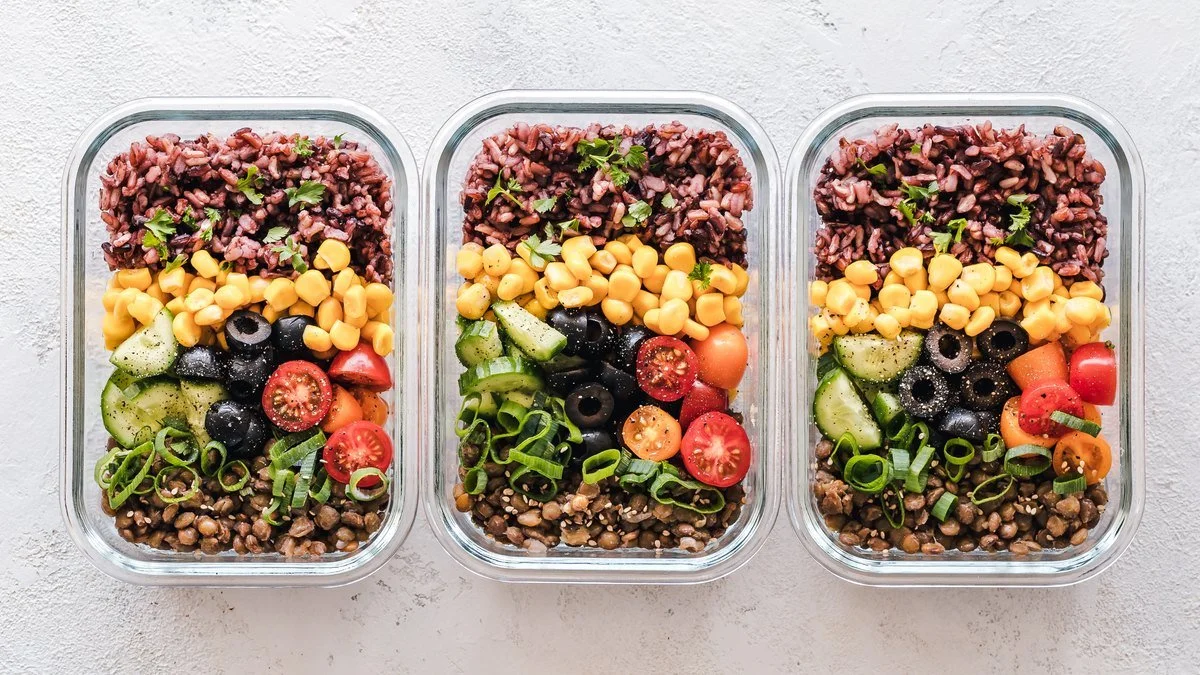
Prepping a few repeatable meals makes the daily numbers much easier to hit.
Step 4: Aim for close, not exact
Chasing the last five grams is how people burn out. Your targets are better treated as a weekly average than a daily exam. A day that lands within 5–10% is doing its job, and a slightly low Tuesday tends to be balanced by a slightly high Thursday.
If you want to tighten the sample day, the fixes are small: swap the peanut butter for an extra half cup of yogurt and protein goes up while fat comes down. You don’t need a new plan, just one adjustment.
Want the week built for you? Start your free 7-day trial.
Step 5: Turn one day into a week
You don’t need seven different days. Most people who stick with macro meal planning repeat far more than they expect:
• Breakfast: one or two options, on rotation.
• Lunch: two or three, often built from the same cooked protein and grain.
• Dinner: this is where the variety goes. Four or five different dinners, with one or two repeated or eaten as planned leftovers.
That’s roughly ten distinct meals covering 21 slots. It’s less work to plan, cheaper to shop for, and easier to hit your numbers with, because you’ve already checked the maths on most of the week.
Step 6: Build the grocery list from the plan
Write the meals first, then read the list off them. Add up the quantities across the week (how much chicken, how many cups of rice, how many tubs of yogurt) and group them by aisle so the shop is one pass.
A list that comes out of the plan means everything you buy has a meal waiting for it, and every meal has its ingredients in the house.
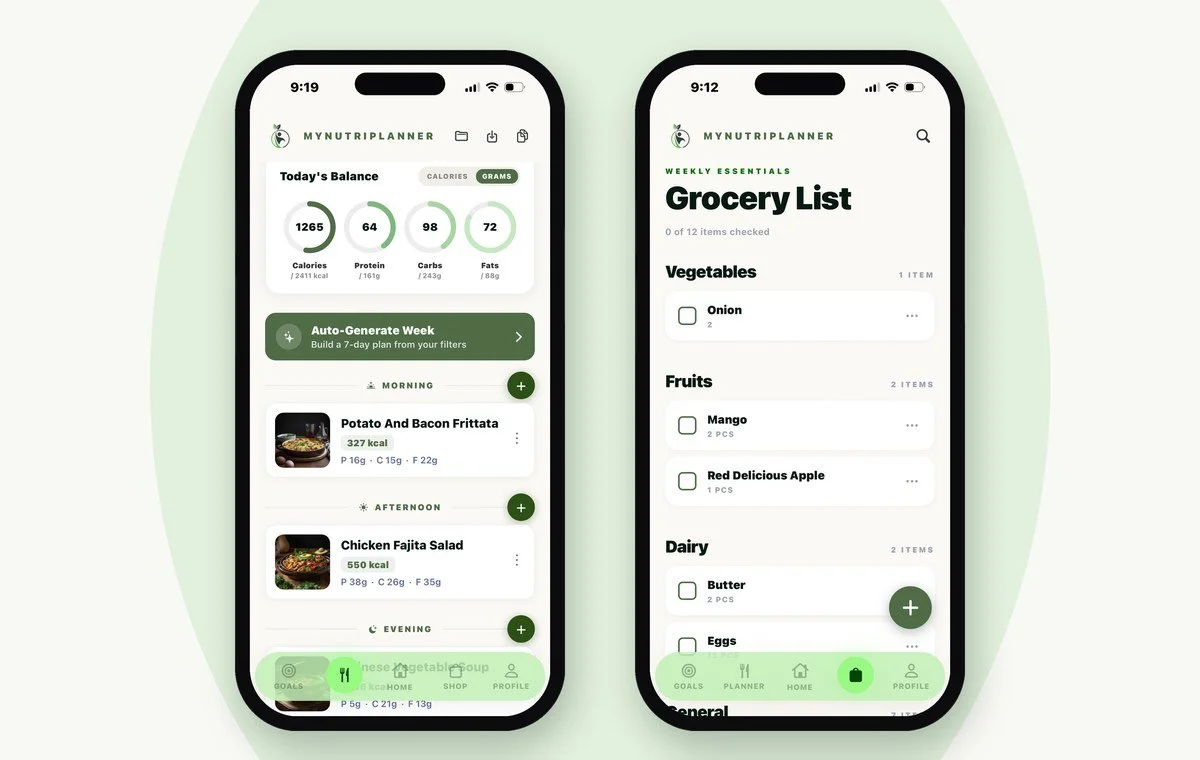
Plan first, list second: every ingredient has a meal waiting for it.
Common mistakes
• Leaving protein until dinner. If breakfast and lunch are light, dinner has to carry 90 g, and that’s a lot of chicken. Spread it out.
• Forgetting cooking fats and drinks. A tablespoon of oil is around 14 g of fat [4]. A flavoured coffee can be a snack’s worth of carbs.
• Mixing up raw and cooked weights. Rice roughly triples in weight when cooked; meat loses weight. Check which one your numbers refer to.
• Planning seven brand-new dinners. Ambition on Sunday is takeout by Thursday. Repeat things.
• Re-planning from scratch every week. Keep what worked. Change two or three meals, not twenty-one.
The shortcut
Everything above is doable with a spreadsheet and a free evening. It’s also exactly the job MyNutriPlanner was built for.
You set your targets (or let the app calculate them with science-backed formulas), and Auto-Generate Week builds seven days from a library of more than 50,000 recipes, balanced to your numbers. Swap any meal you don’t like, and the whole week turns into one grocery list grouped by aisle. See how the app helps you plan meals around your macros.
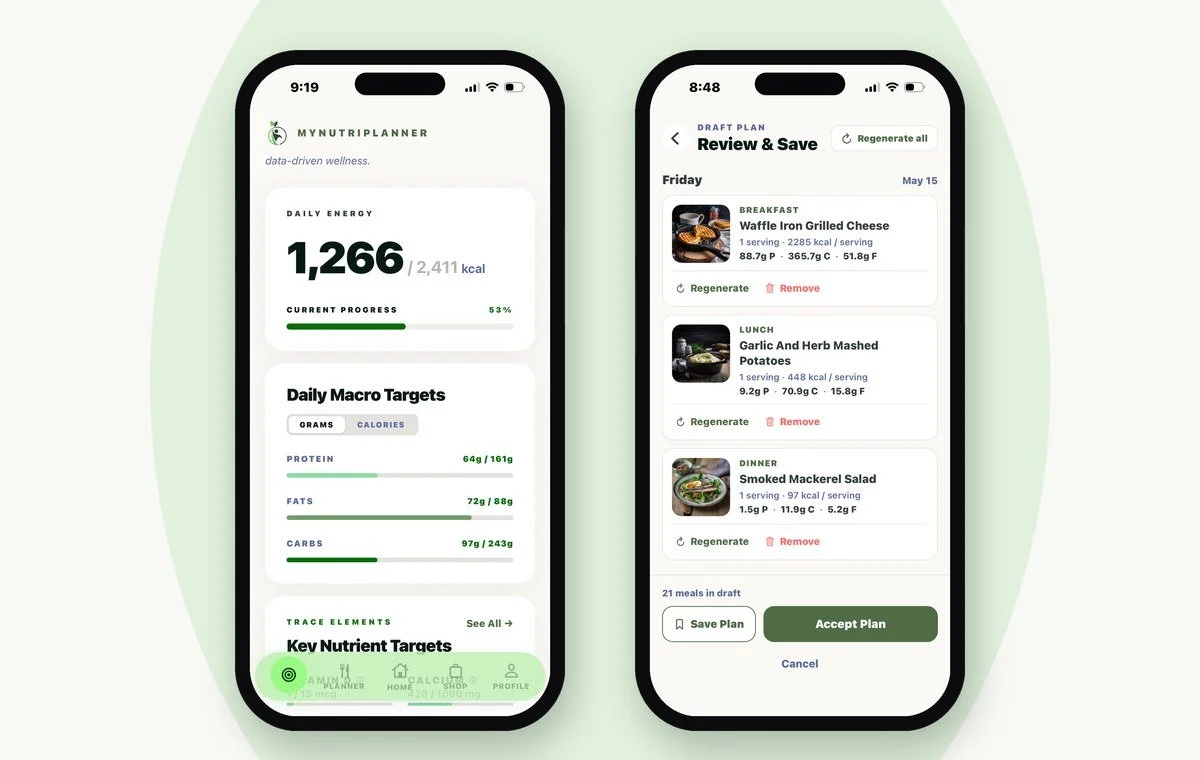
Set the targets once and let Auto-Generate Week build the plan.
Frequently asked questions
How do I start meal planning for macros as a beginner? Get your three daily targets, split them across your meals, choose a protein source for each meal, then add carbohydrates, vegetables and fats to fit. Start with one day, then repeat and vary it into a week.
Do I have to hit my macros exactly every day? No. Landing within about 5–10% is a realistic aim, and looking at your average across the week is more useful than judging any single day.
Which macro should I plan first? Protein. It’s the hardest to reach by accident, so anchoring each meal with a protein source makes the rest of the plan much easier to balance.
How many different meals do I need in a week? Fewer than you’d think. Around ten distinct meals, with breakfasts and lunches on rotation and most of the variety at dinner, is enough for most people.
Is there an app that builds a meal plan from my macros? Yes. MyNutriPlanner generates a full week against your targets and creates the grocery list to match. It’s a planning and tracking tool, not medical advice.
Take the guesswork out of meals. Start your free 7-day trial of MyNutriPlanner and build your first week in minutes. Not sure of your numbers yet? Start with the free macro calculator.
Sources
1. USDA National Agricultural Library, Food and Nutrition Information Center. “How many calories are in one gram of fat, carbohydrate, or protein?” https://www.nal.usda.gov/programs/fnic
2. U.S. Department of Agriculture and U.S. Department of Health and Human Services. Dietary Guidelines for Americans, 2020–2025. https://www.dietaryguidelines.gov
3. Institute of Medicine. Dietary Reference Intakes for Energy, Carbohydrate, Fiber, Fat, Fatty Acids, Cholesterol, Protein, and Amino Acids. National Academies Press, 2005. https://nap.nationalacademies.org/catalog/10490
4. USDA Agricultural Research Service. FoodData Central. https://fdc.nal.usda.gov
5. Mamerow MM, Mettler JA, English KL, et al. Dietary protein distribution positively influences 24-h muscle protein synthesis in healthy adults. Journal of Nutrition. 2014;144(6):876–880. https://pmc.ncbi.nlm.nih.gov/articles/PMC4018950
